AI Security Breaches: The Real Impact & Maturity Prevention
Artificial Intelligence is transforming banking, healthcare, retail, manufacturing, and national infrastructures. However, rapid model adoption has introduced unprecedented cyber risks. Analyzing real-world breaches demonstrates how maturity frameworks safeguard systems.
AI Security Breaches Infographic
A comprehensive threat landscape visualization mapping model vulnerabilities, attack routes, and governance solutions.
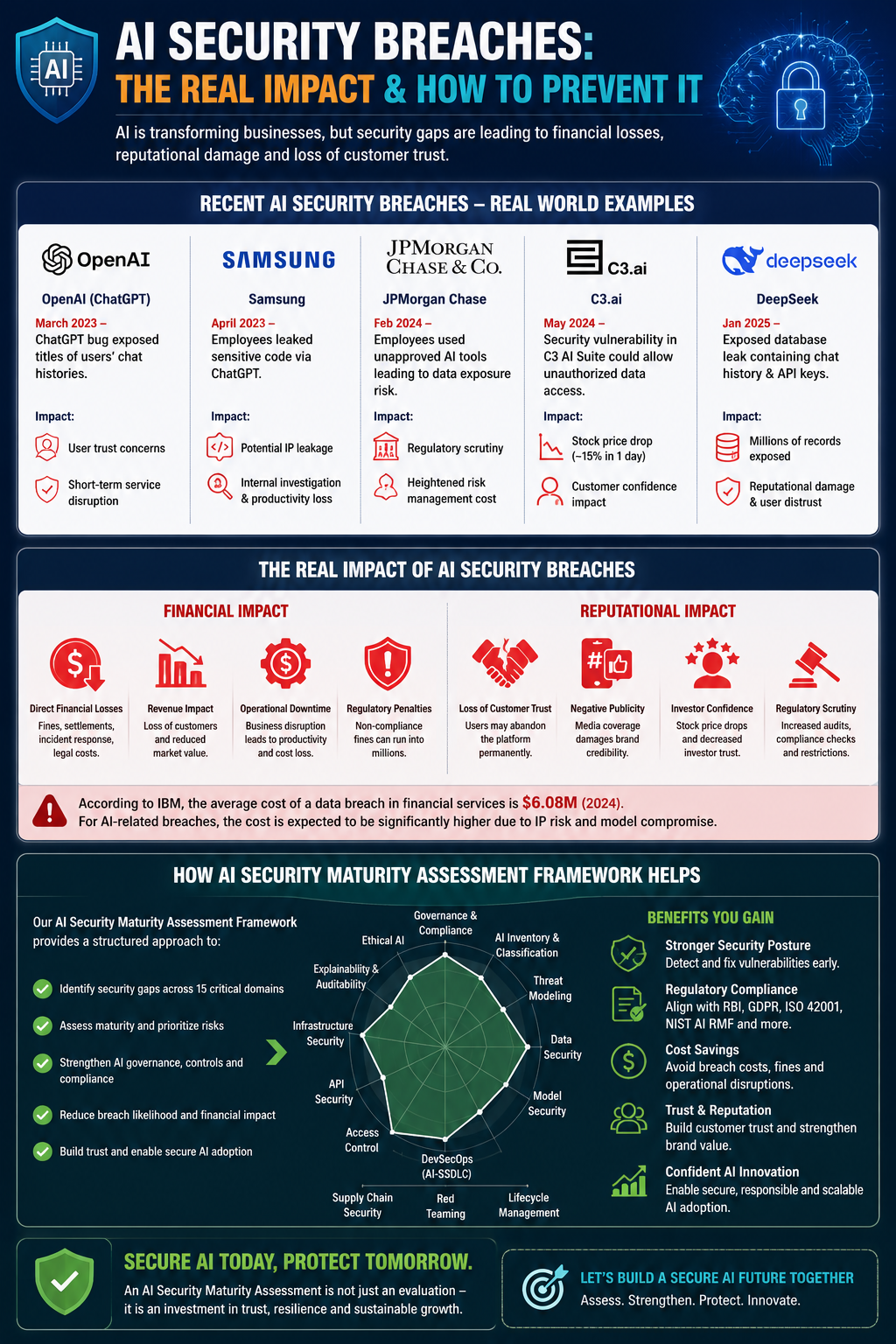
Real-World AI Security Incidents
Recent AI incidents demonstrate that vulnerabilities in machine learning models and pipelines quickly escalate into boardroom-level business and brand risks.
| Organization | Vulnerability & Incident | Operational Impact |
|---|---|---|
| OpenAI | Software-driven chat log exposure bugs. | Erosion of developer trust and localized data leaks. |
| Samsung | Confidential enterprise source code pasted into public LLM. | Confidential intellectual property leakage. |
| JPMorgan Chase | Restrictions imposed on unauthorized third-party model usage. | Compliance risk containment and data leaks prevention. |
| C3.ai | Access vulnerability permitting lateral data access. | Immediate brand equity and market value impact. |
Financial & Brand Impact of AI Breaches
Financial Impact Categories:
- Regulatory Penalties: Substantial fines under newly enacted EU AI Acts and security acts.
- Operational Halts: Significant downtime spent rebuilding models, verifying data, and running audits.
- Remediation Cost: Expansive engineering hours spent identifying data poisoning and retraining models.
- Premium Surges: Dramatic increases in cybersecurity insurance costs due to model failures.
Reputational & Brand Impact:
- Erosion of Customer Trust: Customers withdrawing business due to confidential data leaks.
- Negative Media Telemetry: Damaged reputation across global technical and business journals.
- Reduced Investor Confidence: Declining market capitalization and lower stock multiples.
How the AI Security Maturity Framework Prevents Breaches
The AI Security Maturity Assessment Framework provides a structured, multi-domain control checklist to audit, defend, and optimize model security across the entire enterprise.
Enforced Governance
Align model development with emerging international standards like NIST AI RMF, ISO 42001, and the EU AI Act.
Risk Visibility
Identify active risks, discover shadow models, and secure unmonitored API connection vectors.
Operational Resilience
Build real-time anomaly telemetry, rapid threat intelligence triage, and automated failover pipelines.
Secure Innovation
Adopt state-of-the-art transformers and models while minimizing exposure to regulatory and cyber threats.
Core Components of the Framework
The 15 critical assurance domains audited under our assessment framework to isolate, score, and remediate systemic gaps:
- GRC Policies: Policies aligned with NIST AI RMF & ISO 42001.
- Asset Inventory: Cataloging datasets, endpoints, weights, and versions.
- Threat Modeling: Pre-deployment neural attack surface mapping.
- Data Security: PII anonymization, poison prevention, and leakage protection.
- Model Security: Neural weight encryption and input filter validation.
- DevSecOps (AI-SSDLC): Automated scanning of ML pipelines.
- API Security: Rate-limiting, token auth, and payload screening.
- Supply Chain Audit: Dependency tracking for open-source packages.
- Red Teaming: Structured adversarial model attacks.
- Monitoring & Detection: Drift analysis, model telemetry, and anomaly logs.
Strategic Maturity Benefits
Short-Term
Rapidly isolate immediate gaps, compliance warnings, and shadow LLM integrations within 30 days.
Medium-Term
Achieve structured, audit-ready compliance postures and significantly lower vulnerability densities.
Long-Term
Build absolute market trust, enable fast model deployments, and capture superior competitive advantages.